
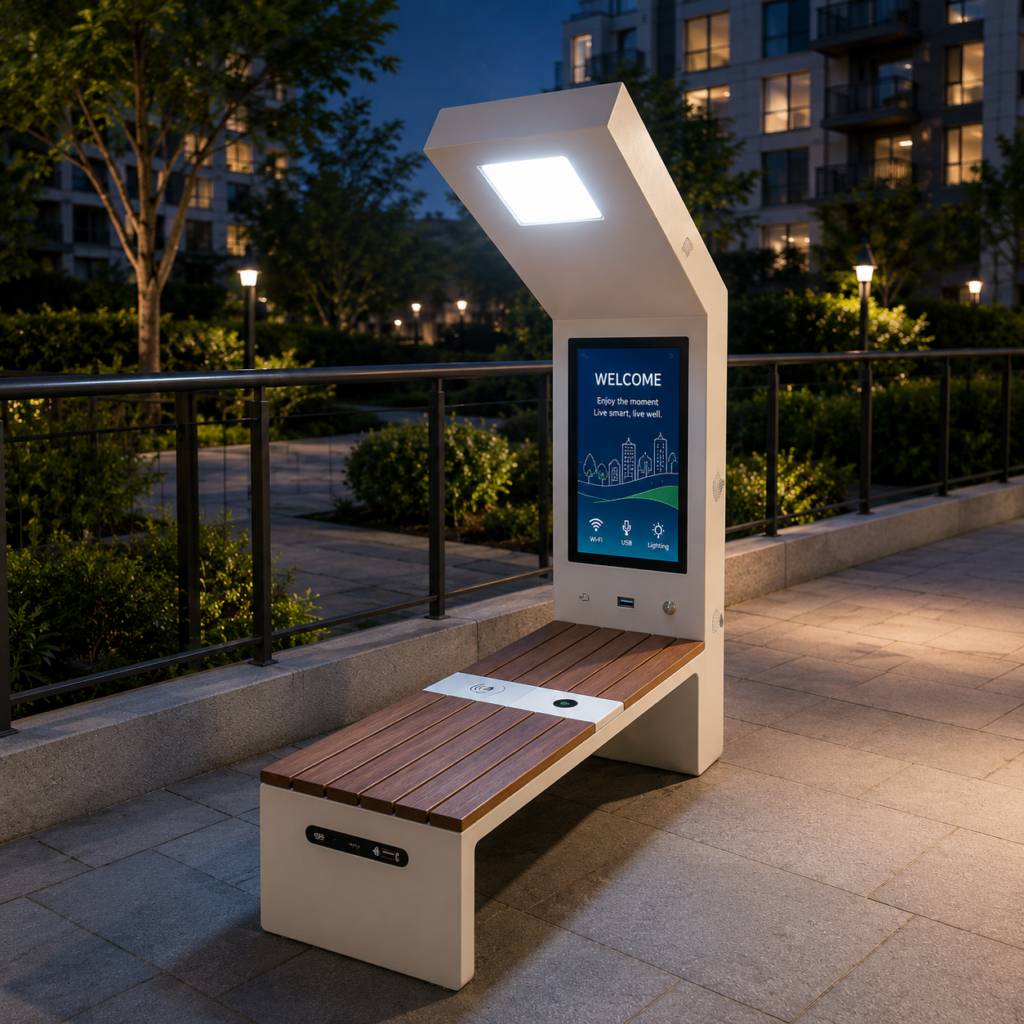
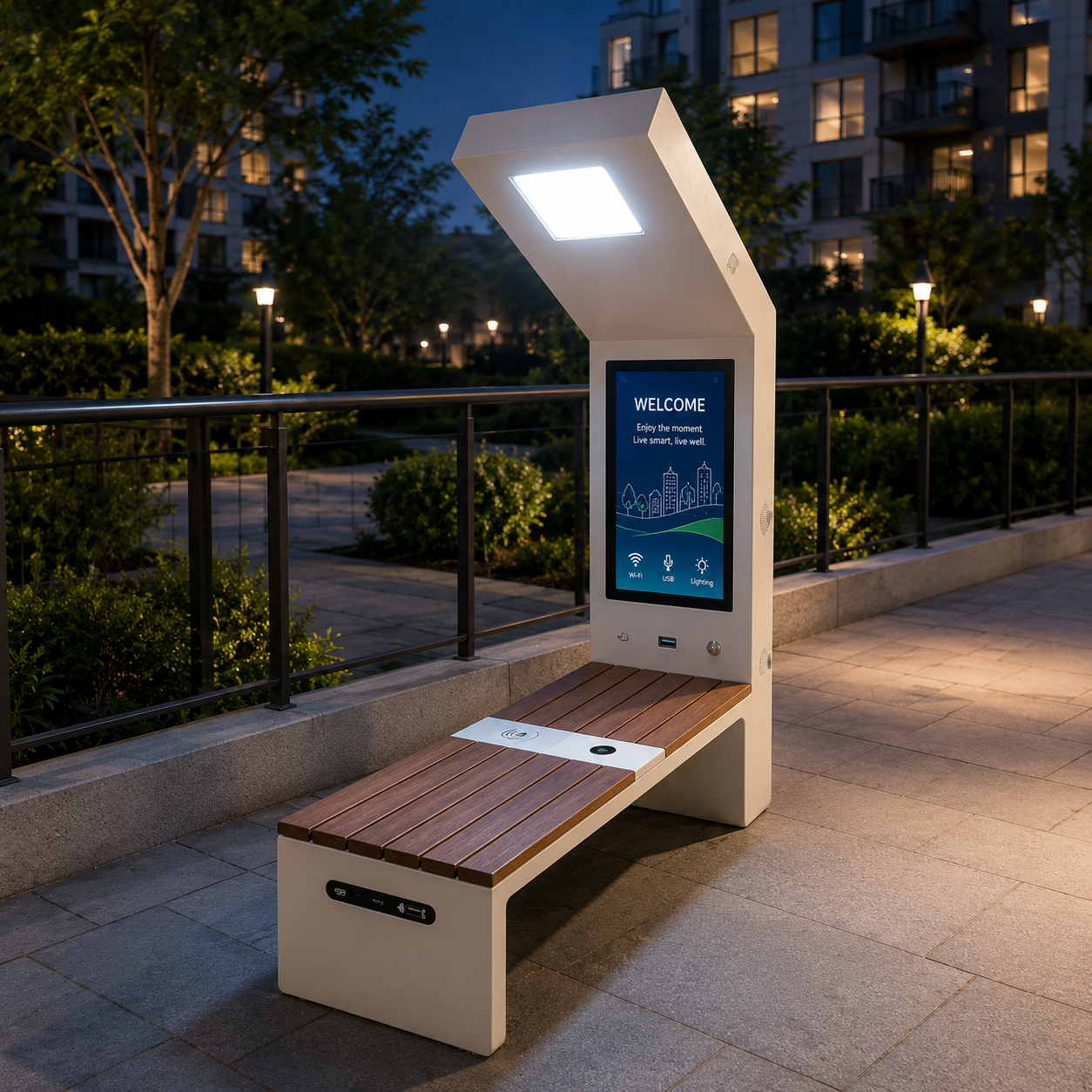
A solar powered bench combines public seating with a small, self-contained photovoltaic power system. During daylight hours, its solar panel converts sunlight into electricity. A controller manages that energy, a rechargeable battery stores it, and protected output modules supply power to features such as USB charging ports, wireless charging pads, LED lighting or environmental sensors.
Unlike a conventional park bench, a solar power bench is both furniture and infrastructure. It can improve the user experience in parks, campuses, transit areas, promenades and commercial developments without requiring a continuous grid connection at every seat.
That does not mean every solar bench works the same way. Panel area, battery capacity, charging output, enclosure protection, construction materials and control logic can vary considerably. Project buyers therefore need to understand the complete system rather than selecting a model only by appearance.
What Components Are Inside a Solar Powered Bench?
Most commercial solar power benches contain six main groups of components.
1. Photovoltaic panel
The photovoltaic panel is the visible energy-generating component. Depending on the design, it may be integrated into a canopy, backrest, tabletop or separate raised structure.
Panel position affects both appearance and performance. A panel should receive useful sunlight without being heavily shaded by trees, nearby buildings or other street furniture. The U.S. Department of Energy notes that PV orientation, tilt, structural support and electrical load requirements are all part of system design. For a solar bench project, those principles should be considered together with the actual site layout rather than copied from a generic product specification.
2. Charge controller
The charge controller sits between the panel and the battery. It regulates charging and helps protect the battery from unsuitable charging conditions. More advanced controls may also manage loads, schedule lighting or disconnect nonessential functions when the battery reaches a low state of charge.
This component is easy to overlook because users cannot see it, but it has a significant influence on day-to-day reliability.
3. Rechargeable battery
The battery stores energy for cloudy periods, evening use and short-term changes in demand. Battery capacity should be selected from the expected daily energy generation and consumption, not from a single headline number.
For example, a bench that only supports modest USB charging has a different load profile from one that also powers lighting, wireless chargers, Wi-Fi equipment and a digital display. Local temperature conditions, desired autonomy and the permitted depth of discharge also influence battery selection.
4. Charging outputs
A solar bench may offer:
- USB-A ports;
- USB-C ports;
- wireless charging pads;
- protected low-voltage outlets;
- or a combination of these options.
The useful specification is not simply the number of ports. Buyers should confirm output power, simultaneous-use behavior, connector protection, replacement access and what happens when stored energy is low. These questions are covered in more detail in our solar bench charging station guide.
5. Structural body and seating surface
The structure supports users, protects electrical components and resists outdoor exposure. Common options include painted or powder-coated steel, stainless steel, aluminum and mixed structures with wood or wood-plastic composite seating surfaces.
The correct choice depends on corrosion conditions, expected use, maintenance resources, visual requirements and budget. Coastal sites, high-humidity areas and locations where de-icing salts are used require special attention to materials, fasteners, drainage and surface treatment.
6. Optional smart functions
Depending on the project, solar panel benches can include:
- LED ambient or safety lighting;
- Wi-Fi equipment;
- environmental sensors;
- equipment-status monitoring;
- occupancy or usage counters;
- emergency-call equipment;
- advertising or information displays;
- Bluetooth audio;
- and custom municipal branding.
More functions are not automatically better. Every additional device adds energy demand, enclosure requirements, maintenance work and potential failure points. Functions should be selected from a real user need and a realistic operating plan.
How Does a Solar Power Bench Work During the Day?
In daylight, the photovoltaic panel produces direct-current electricity. The controller directs available power to the active loads and battery according to the system design. If generation exceeds current demand, the remaining energy can charge the battery. If demand exceeds generation, the battery may supplement the panel.
Actual performance changes throughout the day. Morning and late-afternoon output will normally differ from midday output, and shading can reduce generation. A site survey should therefore consider seasonal sun paths, trees, planned landscaping and nearby structures.
For heavily shaded sites, increasing the battery alone may not solve the underlying problem. The project team may need to change the bench location, alter the panel arrangement or consider a hybrid power option.
How Does It Work at Night or in Cloudy Weather?
At night, the bench operates from stored battery energy. During cloudy weather, the solar panel may continue producing power, but usually at a lower level than under strong sunlight.
Whether the bench remains fully functional depends on:
- usable battery capacity;
- recent solar generation;
- charging demand;
- lighting schedules;
- controller settings;
- temperature;
- and the priority assigned to each load.
A well-designed system can prioritize essential functions. For instance, decorative lighting or wireless charging may be limited before basic low-power charging is disabled. Buyers should ask the manufacturer to describe this low-energy behavior in the quotation.
Does a Solar Bench Need a Grid Connection?
Many solar benches are designed as off-grid products and do not require a permanent electrical supply. That can reduce trenching and cabling at suitable sites.
However, “solar powered” should not be interpreted as “no planning required.” The bench still needs secure anchoring, suitable solar access, drainage, safe circulation space and an inspection plan. Some projects may also benefit from a hybrid or grid-assisted design when loads are high, shade is unavoidable or continuous availability is critical.
The correct decision is based on the site and service requirement, not on the label alone.
Where Are Solar Panel Benches Commonly Used?
Solar benches are suitable for locations where people already pause and where access to power adds value, including:
- municipal parks and plazas;
- school and university campuses;
- transit waiting areas;
- pedestrian streets;
- business parks;
- shopping and mixed-use developments;
- tourist sites;
- waterfront promenades;
- hospital and community campuses;
- and outdoor event areas.
Placement should support the surrounding circulation pattern. The bench should not block a required accessible route, and charging ports should be reachable without forcing cables across a busy path.
What Are the Main Benefits?
Useful public charging
Device charging gives visitors a practical reason to use the seat and can improve the experience at locations with longer dwell times.
Reduced dependence on local cabling
At an appropriate solar site, an off-grid bench may avoid some trenching and electrical connection work. This benefit should be evaluated against foundation, transport and maintenance requirements.
Flexible project customization
Structure, seating materials, colors, branding, charging modules, lighting and smart functions can be adapted to the project.
Visible sustainability feature
A solar bench makes renewable-energy infrastructure visible and understandable to the public. It can support a broader smart-campus or smart-city program when the technology is matched to a genuine service need.
What Are the Limitations?
Solar power benches also have limitations that buyers should address early:
- Solar generation depends on location, season and shading.
- Batteries and electronic modules have finite service lives.
- Outdoor charging interfaces require inspection and replacement access.
- Vandalism risk influences component placement and fastener selection.
- More smart functions increase power demand and maintenance complexity.
- A visually attractive product can still perform poorly if the energy balance is not calculated for the site.
A credible supplier should be willing to discuss these limits rather than promise identical performance in every climate and location.
What Specifications Should a Buyer Confirm?
Before requesting a final quotation, confirm at least the following:
- Installation city and site conditions.
- Expected hours of direct sunlight and known shading.
- Panel type and rated power.
- Battery chemistry, rated capacity and accessible replacement method.
- Number and output of charging interfaces.
- Expected simultaneous users.
- Lighting and other optional loads.
- Structural material and surface treatment.
- Enclosure and connector protection requirements.
- Foundation and anchoring method.
- Required color, logo and visual design.
- Inspection, spare-parts and warranty expectations.
For a complete procurement checklist, see our solar bench buying guide for schools, parks and campuses.
Frequently Asked Questions
Is a solar powered bench completely off-grid?
It can be, but the correct configuration depends on solar access, electrical loads and the availability required by the project. High-load or heavily shaded sites may need a different arrangement.
Can solar benches charge several phones at once?
Yes, if the controller, battery and output modules are designed for the combined load. Buyers should request the simultaneous output specification rather than relying only on the number of ports.
Do solar power benches work in winter?
They can operate in winter, but shorter days, low sun angles, snow, temperature and local weather affect generation and stored energy. The project specification should be based on local conditions.
Are solar benches waterproof?
Outdoor models should use protected enclosures, connectors and drainage details appropriate to the site. Ask which components were tested and which protection classification is claimed. IEC 60529 is the international standard associated with enclosure IP classifications.
Can the design be customized?
Commercial solar benches can typically be customized in dimensions, structure, seating finish, color, branding, charging configuration and optional functions, subject to engineering review.
Plan the Bench as a Complete System
A solar powered bench is not simply a park bench with a panel attached. It is a coordinated system involving solar generation, energy storage, protected electronics, structural design and public-space planning.
When those parts are specified together, solar benches can provide reliable seating, charging and smart functions in a wide range of public projects. When they are selected only by appearance or nominal battery size, performance and maintenance problems become much more likely.
Yubang develops custom solar smart benches for public outdoor spaces. Send the installation location, required functions, expected daily use, finish and quantity to receive a project-specific configuration and quotation.
Suggested external references
- U.S. Department of Energy, Solar Photovoltaic System Design Basics: https://www.energy.gov/cmei/systems/solar-photovoltaic-system-design-basics
- IEC 60529, Degrees of protection provided by enclosures: https://webstore.iec.ch/en/publication/2452
