
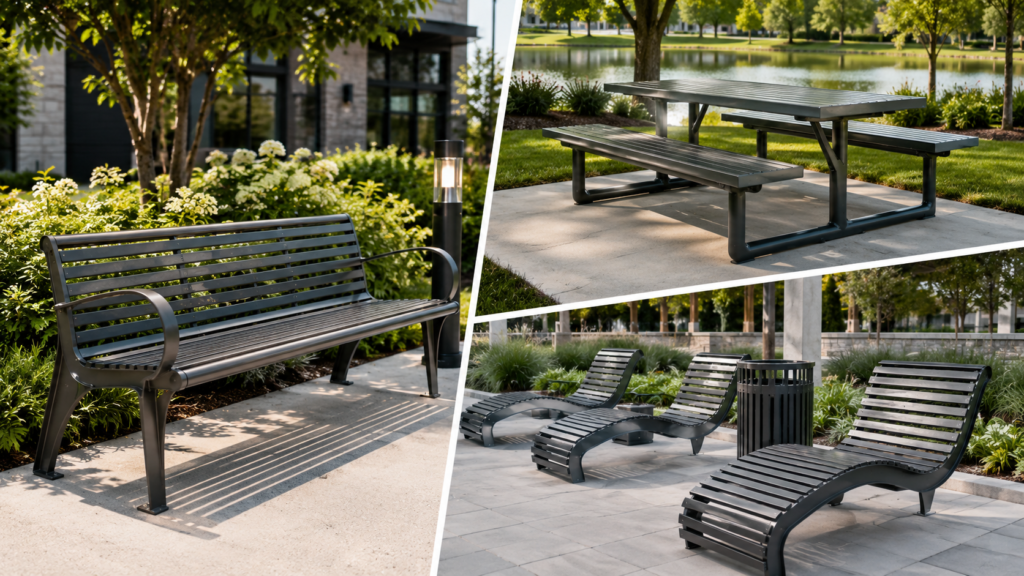
Outdoor furniture materials affect far more than appearance. They influence structural design, surface treatment, transport, installation, cleaning, repair and the way a public-space product ages. For a park, campus, streetscape or commercial plaza, the right decision usually comes from matching each component to its job instead of selecting one material for the entire product.
This outdoor furniture materials comparison is written for project buyers, landscape teams, contractors and distributors. It explains how steel, stainless steel, aluminum, wood-plastic composite and outdoor-grade plastics are commonly evaluated. It also provides a practical method for comparing site amenity equipment without making unsupported assumptions about service life or performance.
Start with the Site, Not the Material Name
A material that works well in one location may be unsuitable in another. Exposure to moisture, salt, sunlight, dust, temperature changes and frequent contact all matter. The product’s form, drainage, joints and finish can be just as important as the base material. Buyers should therefore describe the installation environment before asking a supplier to recommend a specification.
Record Environmental Exposure
Document whether the site is inland or coastal, covered or fully exposed, shaded or in direct sun, and easy or difficult to clean. Identify sources of standing water, irrigation spray, road salt, sand or chemical cleaners. This information helps the design team consider corrosion protection, color stability, drainage and accessible maintenance.
Define User Load and Operating Conditions
Public use is not uniform. A quiet garden, school courtyard, transit interchange and busy commercial plaza have different traffic patterns. Record expected use, possible misuse, maintenance frequency and the need to move or permanently anchor each item. A qualified project engineer should confirm structural loads, foundations and local compliance requirements.
Outdoor Furniture Materials at a Glance
The following table is a screening tool, not a final specification. Grades, section sizes, finish systems and construction details vary. Buyers should ask suppliers to state these details rather than relying on a general label such as “metal bench” or “stainless product.”
| Material | Typical project use | Potential advantages | Items to verify |
|---|---|---|---|
| Carbon or galvanized steel | Frames, legs, posts, benches, tables and bins | Wide range of sections and fabrication options | Grade, thickness, drainage, welding and coating system |
| Stainless steel | Visible trim, contact surfaces, hardware and complete assemblies | Corrosion resistance and a clean architectural finish | Grade, finish, cleaning method and dissimilar-metal contact |
| Aluminum alloy | Frames, slats, panels, roofs and lightweight assemblies | Low weight and natural resistance to red rust | Alloy, wall thickness, connection method and surface finish |
| Wood-plastic composite | Seat slats, backrests, table surfaces and decorative elements | Wood-like appearance with no routine painting of the slat material | Composition, support spacing, heat exposure, fasteners and replacement supply |
| Outdoor-grade plastic | Seat shells, modular parts, liners and selected bins | Low weight, easy cleaning and molded forms | Resin type, UV stabilization, wall thickness and repair or recycling route |
Steel for Structural Frames and High-Use Areas
Steel is frequently used where a rigid frame, familiar fabrication process or broad choice of sections is required. It can be formed and welded into benches, table frames, litter bins and other public amenities. The finished performance depends on the steel grade, section design, weld quality, drainage and corrosion-protection system.
When Galvanizing and Coating Matter
Galvanizing and paint or powder-coating systems serve different roles, and the correct combination depends on the environment and design. Edges, welds, enclosed cavities and drainage holes deserve attention because water can collect at poorly detailed points. Ask the supplier to describe surface preparation and coating steps. The site’s cleaning and repair team should also understand how local coating damage will be treated.
Questions to Ask About Steel Products
Request the proposed grade, material thickness, tube or plate dimensions, welding approach, finish system and fixing details. For a public bench or table, also ask how water drains from horizontal members and how contact between different metals is managed. The guide on preventing rust on outdoor metal furniture provides additional maintenance context.
Stainless Steel for Corrosion-Sensitive Components
Stainless steel is used in outdoor furniture when the design needs corrosion resistance, a metallic appearance or easy-to-clean exposed surfaces. It is not maintenance-free. Grade selection, fabrication, surface contamination, crevices and cleaning practice influence results. Coastal or chemical exposure should be explained clearly so the project team can assess an appropriate grade and finish.
Use Stainless Steel Selectively
A complete stainless-steel product is not always necessary. Some projects use stainless steel for fasteners, trim, handles or highly exposed elements while using coated steel or aluminum elsewhere. Component-by-component selection can balance appearance, weight, fabrication and budget. Any contact between unlike metals should be reviewed as part of the detailed design.
Aluminum for Lightweight Outdoor Assemblies
Aluminum alloy is common in slats, frames, panels and products that benefit from lower transport weight. It does not produce red rust, although it can still corrode in unsuitable conditions. Alloy, extrusion geometry, wall thickness, heat treatment, connection design and finish must be evaluated together. A lighter component is useful only if the structure is designed for the actual application.
Check Connections and Section Design
Because aluminum behaves differently from steel, buyers should not compare two products only by their outer dimensions. Ask for material and section information, connection details and the intended finish. For a focused comparison, see steel versus aluminum outdoor furniture.
Wood-Plastic Composite for Contact Surfaces
Wood-plastic composite, usually shortened to WPC, is used for bench slats, backrests and table surfaces when a wood-like visual effect is desired. Products vary by formulation and geometry, so the term WPC alone is not a specification. Support spacing, thermal movement, fastener design, color, surface temperature and replacement availability should be reviewed.
Plan for Expansion and Replacement
Composite slats can expand and contract with temperature. The supplier should define suitable gaps and fixing methods for the selected profile. Buyers should also confirm whether individual slats can be replaced without dismantling the complete bench. Keeping the profile and color reference in the handover file makes future maintenance easier.
Outdoor-Grade Plastic for Molded Components
Plastic can suit molded seating, liners, containers and modular elements. Its low weight and washability may be helpful, but outdoor performance depends on the resin, pigments, UV stabilization, wall thickness and structural form. Ask for a precise material description and avoid assuming that all products described as outdoor plastic are equivalent.
Consider Repair and End-of-Life Handling
Confirm whether damaged components can be replaced individually and whether the material has an identified recycling or disposal route in the destination market. A product that is easy to disassemble may simplify both repairs and end-of-life sorting. These practical points belong in the purchasing decision, even when they are not visible in a product photograph.
Combine Materials by Component
Many durable outdoor products are mixed-material assemblies. A bench may use a coated steel frame, aluminum or WPC slats, stainless fasteners and plastic end caps. A recycling station may combine a metal enclosure with removable liners, labels and hinges. Each material should be assigned to a function, and the interfaces should be detailed to avoid trapped water, abrasion or difficult servicing.
Benches and Public Seating
For benches, compare the frame, seat and backrest separately. Consider comfort, drainage, surface temperature, ease of cleaning, replaceable slats and anchoring. Buyers can review the outdoor bench buying guide, the custom metal bench product page and custom outdoor park benches.
Tables, Bins and Planters
Tables need stable frames, cleanable surfaces and enough clearance for the intended users. Bins need practical door, liner and opening details. Planters must account for soil, water, drainage and movement. Relevant product routes include outdoor table and chair sets, outdoor recycling and trash bins and outdoor planter boxes.
Material Selection for Commercial Plaza Site Amenities
Commercial plaza site amenity equipment usually needs a coordinated appearance across several product types. Material decisions should connect seating, waste collection, planters, shade and information elements. A consistent color family can unify the space, while different base materials may be used where each performs a different job.
Coordinate Appearance and Maintenance
Ask whether facilities staff can use compatible cleaning methods across the selected products. Highly reflective finishes, textured coatings, composite slats and transparent panels may require different care. A finish sample viewed under the project’s actual lighting is more useful than relying only on a screen image.
Keep Circulation and Accessibility Clear
The material choice cannot solve a poor layout. Position furniture so it supports rest and social use without narrowing accessible routes or blocking entrances. Foundations and anchors should coordinate with paving, drainage and underground services. Use the public facility product selection guide for a broader site-planning checklist.
Compare Total Project Requirements
Unit price alone cannot show whether two offers are technically equal. Compare material grade, thickness, surface preparation, finish, dimensions, functions, packaging, delivery scope and documentation. Where a requirement is unknown, label it as pending instead of allowing each supplier to make a different assumption.
| Decision factor | Information to request | Comparison question |
|---|---|---|
| Environment | Exposure description and proposed protection | Does the proposal address the actual site? |
| Base material | Grade, alloy, resin or composite profile | Are suppliers pricing the same material category? |
| Structure | Sections, thicknesses, joints and anchoring concept | Can the design be reviewed for the intended use? |
| Finish | Preparation, coating or surface finish and color | Is the full finish system described? |
| Maintenance | Cleaning, inspection and replacement access | Can the operator service common wear parts? |
| Logistics | Packing method, assembly level and unloading needs | Is delivery practical for the site? |
| Documentation | Drawings, samples, manuals and part references | Will approvals and future maintenance be traceable? |
The materials and surface treatment overview can support this comparison. Buyers looking for coordinated product families can also review the park and outdoor furniture collection.
Prepare a Clear Material Specification
A useful specification names the component, base material, grade or type, dimensions, finish, color and relevant connection details. It also records the site exposure and required approvals. Avoid broad phrases such as “high-quality metal” because they do not allow technical comparison. Final structural and compliance decisions should remain with qualified project professionals.
Final Selection Approach
The best outdoor furniture material is the one that fits a defined component, environment and maintenance plan. Start with site conditions, assign materials by function, review interfaces and compare suppliers against the same requirement sheet. Yubang Outdoor provides project-based options across benches, tables, bins, planters and related public facilities. Buyers can contact the project team with site photos, quantities, preferred finishes and required functions for a focused discussion.
Frequently Asked Questions
Which material is best for outdoor public benches?
No material is best for every bench. The frame, seat, environment, anchoring and maintenance plan should be assessed separately. Steel, stainless steel, aluminum and composite slats can each be suitable when their grades, sections, finishes and connections match the project.
Is stainless steel outdoor furniture maintenance-free?
No. Stainless steel still needs suitable grade selection, good fabrication and regular cleaning. Salt, contaminants and crevices can affect exposed surfaces, so the cleaning method should match the site and finish.
Does aluminum outdoor furniture rust?
Aluminum does not form red iron rust, but it can corrode under unsuitable conditions. Alloy, finish, drainage and contact with other metals should be reviewed as part of the product design.
How should commercial plaza site amenity supplies be coordinated?
Coordinate their layout, color family, cleaning requirements, anchoring and replacement access. The base material can vary by component while the overall appearance remains consistent. A schedule covering benches, tables, bins and planters helps control these decisions.
What should a buyer request in an outdoor furniture quotation?
Request dimensions, quantities, material grades or types, thicknesses, finish system, color, functions, packaging, delivery scope, drawings and exclusions. Yubang Outdoor can review this project information and propose available customization options, but site engineering and local approvals should be confirmed by qualified parties.
How can I reduce maintenance problems after installation?
Choose accessible, drainable and replaceable components; keep material and finish records; and provide cleaning and inspection instructions to the operator. A practical maintenance plan prepared before purchase is more effective than reacting after visible damage appears.
