
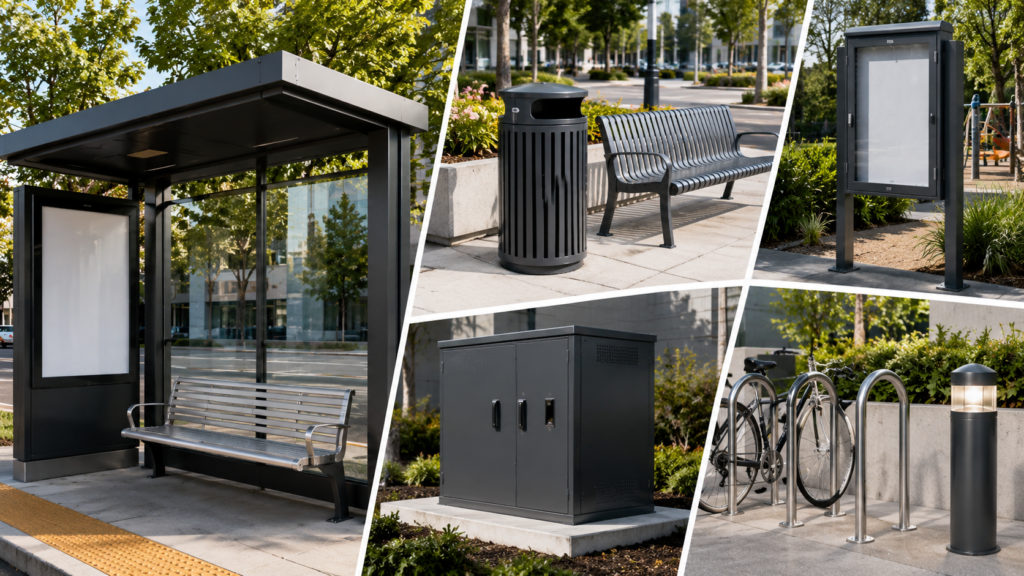
Choosing outdoor public facility products is a project decision, not a catalogue decision. A bench, recycling station, bus shelter, display unit or solar-powered amenity must fit the site, serve the intended users and remain practical throughout installation and maintenance. The most useful specification is therefore the one that connects the product to its operating environment.
This guide gives landscape architects, municipal buyers, contractors, distributors and project owners a clear way to compare outdoor public facility products without relying on unverified performance claims. It covers site assessment, materials, functions, installation, supplier review and quotation preparation so that early decisions are easier to document and compare.
Define the Public-Space Application First
Begin with the location and the user journey. A transit stop may require weather protection, seating, route information and an advertising surface. A park rest area may combine benches, tables, litter bins and shade. A commercial plaza may need coordinated seating, wayfinding, planters and display structures. Each application creates a different balance between comfort, visibility, durability and maintenance access.
Identify Users, Dwell Time and Traffic Flow
Record who will use the space, how long they normally stay and how they move through it. Short stops need clear circulation and convenient waste collection. Longer stays may call for backrests, shade, tables or device-charging options. Accessibility routes, emergency access and maintenance paths should stay clear after every product is placed.
Separate Essential and Optional Functions
Create two lists before requesting quotations. The essential list should contain functions required for the site to operate. The optional list may include upgrades such as lighting, branded panels, solar power or additional display space. This separation prevents an attractive feature from obscuring a basic requirement and makes supplier quotations easier to compare.
Complete a Site Assessment Before Product Selection
Site information reduces redesign. Provide usable dimensions, photographs, access limitations and known ground conditions. Note exposure to rain, strong sunlight, airborne salt, dust or frequent public contact. If wind, snow, seismic, accessibility or electrical requirements apply, the project engineer or local authority should define the relevant criteria before a final structure is approved.
Measure Space, Clearances and Interfaces
Check more than the product footprint. Include door swings, poster-changing space, bin-emptying routes, roof overhangs, passenger circulation and the working area required by installers. Also identify interfaces with paving, foundations, drainage, electrical conduits and nearby street furniture. A small clearance conflict can create expensive site changes later.
Document Climate and Maintenance Conditions
Climate affects material and finish selection, while maintenance practice affects the most suitable layout. Ask how often the site will be cleaned, who will replace posters or liners, and whether technicians can reach electrical components. A product should be serviceable with the tools and access available to the operator.
Compare Outdoor Materials by Use Case
There is no single best outdoor material. Galvanized steel is widely used for structural frames; stainless steel can suit applications where corrosion resistance and appearance are priorities; aluminum alloy offers low weight and corrosion resistance; tempered glass and polycarbonate may be used for transparent panels; and wood-plastic or other outdoor-grade materials may be selected for contact surfaces. The final choice should consider structure, finish, environment and maintenance together.
| Material or component | Common project role | Questions to confirm |
|---|---|---|
| Galvanized steel | Frames, posts, shelters and robust street furniture | Steel grade, thickness, welding, drainage and coating system |
| Stainless steel | Visible trim, contact surfaces and corrosion-sensitive locations | Grade, finish direction, cleaning method and dissimilar-metal contact |
| Aluminum alloy | Panels, frames, roofs and lightweight assemblies | Alloy, section design, finish and connection method |
| Transparent panels | Shelter walls, display covers and wind screens | Material type, thickness, edge treatment, replacement access and local safety rules |
| Wood-plastic or outdoor slats | Seats, backrests and visual accents | Color, fixing detail, heat exposure, cleaning and replacement availability |
For a deeper material comparison, review the outdoor furniture materials guide and the practical discussion of steel versus aluminum for public spaces.
Specify Surface Treatment as a System
Do not treat color as the entire finish specification. Ask how the substrate is prepared, which coating process is proposed, how edges and welds are handled, and how damaged areas can be repaired. The appropriate system depends on the base material and exposure. For more context, see the overview of materials and surface treatment.
Match Product Families to the Site Plan
Coordinating several product families early can improve circulation and visual consistency. It also helps the buyer identify shared finishes, fixing methods and delivery phases. The aim is not to make every item identical, but to establish a coherent set of forms, colors and service requirements.
Plan a Commercial Plaza Site Amenity Equipment Package
Commercial plaza site amenity equipment should be planned as a coordinated package rather than a list of unrelated products. The package normally connects seating, waste collection, planters, wayfinding, lighting and display structures to the way people enter, cross and use the site. Buyers should begin with activity zones and maintenance routes, then assign suitable products to each zone. This keeps furniture clear of primary circulation while giving visitors practical places to stop, sit and dispose of waste.
Organize Site Amenities Around Plaza Activity Zones
A zone-based schedule makes early drawings and supplier quotations easier to compare. It also shows where one item may interfere with another. For example, a planter can help define a seating area, but its final position should not reduce an accessible route or block the space required to empty a nearby bin. The table below turns common plaza areas into a practical coordination checklist.
| Plaza zone | Possible site amenities | Coordination question |
|---|---|---|
| Main entrance | Wayfinding, planters, branded display elements and short-stay seating | Can visitors see the entrance and route information without furniture narrowing the arrival path? |
| Primary circulation | Directional signs, litter bins and occasional leaning or rest points | Do products remain outside required walking, emergency and maintenance clearances? |
| Seating and dwell area | Benches, tables, shade structures, planters and charging options where appropriate | Does the layout provide usable shade and choice without creating hidden or difficult-to-clean spaces? |
| Food and beverage area | Tables, movable or fixed seating, waste and recycling stations | Can staff clean surfaces and service bins without crossing busy customer routes? |
| Event or promotion area | Outdoor display structures, information boards and removable barriers | Are power, access and artwork-changing requirements defined before the display system is selected? |
| Service edge or perimeter | Screening, bicycle parking, bins and protective street furniture | Can delivery, emergency and maintenance vehicles operate without conflicts? |
The commercial plaza outdoor facility solution provides a related planning route for buyers combining several product families. Use it with a marked site plan so that proposed quantities and locations can be reviewed before detailed product selection.
Create One Finish and Maintenance Matrix
A coordinated appearance does not require every item to use the same construction. Benches, bins, planters and display frames can share a color direction or visible finish while using materials suited to their different loads and service needs. Record the substrate, finish, color reference, exposed fasteners and cleaning method for each product family. The matrix should also note which parts are replaceable and which surfaces will receive the heaviest public contact.
Prepare a Commercial Plaza Site Amenity Supplies RFQ
A useful plaza request for quotation includes a dimensioned layout, product schedule, required quantities, finish matrix, installation responsibility and delivery sequence. Attach photographs of the site and identify any restrictions on lifting, storage or working hours. When alternatives are allowed, ask suppliers to separate the base proposal from optional features. Buyers can then compare the same scope across custom outdoor park benches, outdoor recycling and trash bins and outdoor display structures without treating unlike configurations as equivalent.
Seating and Park Furniture
Evaluate seating capacity, posture, spacing, shade, drainage and the needs of different users. The park and outdoor furniture collection provides an overview, while the custom outdoor park bench page shows a product route for project enquiries.
Recycling and Waste Stations
Waste facilities should be easy for visitors to understand and practical for staff to service. Consider stream labels, opening shapes, liner access, cleaning, stability and placement near activity zones without blocking circulation. Compare the planning factors in the outdoor recycling bin buying guide, then review custom outdoor recycling and trash bins for a related product option.
Transit Shelters and Information Displays
A shelter must integrate structure, passenger flow, visibility and information. Advertising or route-information panels need safe access for content changes. Start with the custom bus shelter product page and use the bus shelter layout guide to compare configurations.
Solar and Smart Outdoor Amenities
Solar-powered products add questions about shade, orientation, energy demand, component access and operating expectations. Buyers should define required functions instead of assuming every smart feature is suitable for every site. The solar smart outdoor products collection and the solar smart bench product page are useful starting points.
Plan Installation and Long-Term Service
Installation should be discussed before production drawings are approved. Confirm how units are transported to the final position, whether they arrive assembled or in modules, what lifting equipment may be needed, and how the structure connects to the foundation. Local engineers and installers remain responsible for confirming foundations, anchors and compliance with site rules.
Coordinate Foundations and Utilities
Mark utilities, drainage and finished paving levels on the site plan. Products with lighting, charging or display components may require cable routes or service access even when part of their energy comes from solar panels. Coordinate these interfaces with civil and electrical work so that installers do not need to improvise on site.
Make Replacement and Cleaning Practical
Ask how common wear components, glazing, locks, posters, liners or electrical modules can be reached and replaced. Surfaces should be cleanable without dismantling unrelated parts. Clear access and replaceable subassemblies can be more valuable over the project life than a small saving in the initial purchase price.
Evaluate Supplier Capability with Evidence
A supplier review should focus on the proposed project, not general promises. Request drawings, material descriptions, finish information, packaging plans and a clear revision process. If several outdoor public facility products are included, confirm who coordinates dimensions, colors and interfaces across the package.
Verify Production Readiness for a Project Order
A workshop video can show the production setting, equipment, and work in progress, but it cannot confirm monthly capacity, lead time, quality level, or availability for a specific order. Buyers should connect visual evidence to the proposed product, approved drawings, quantity, material supply, production schedule, inspection plan, and delivery date.
Capacity Evidence Buyers Should Request
| Question | Evidence to request | Decision supported |
|---|---|---|
| Can this design be produced? | Approved drawing, material list, process plan, and relevant work-in-progress photos | Whether the factory method fits the exact product rather than a general product category |
| Can the order meet the date? | Written schedule covering material preparation, fabrication, finishing, inspection, packing, and dispatch | Whether the proposed lead time includes every required production stage |
| How will quality be checked? | Order-specific checklist, acceptance criteria, photo record, and corrective-action process | Whether the inspection covers dimensions, functions, finish, hardware, and documents |
| How are changes controlled? | Drawing revision, approved sample or finish reference, and written change record | Whether production will follow the latest approved requirement |
| Is the order ready for export? | Packing method, package data, loading plan, labels, and packing list | Whether completed products can be identified, handled, and delivered safely |
Ask suppliers to state assumptions and exclusions in writing. Tooling, samples, engineering review, third-party testing, or special packaging may affect the schedule. For a mixed project, separate lead times may be needed for custom solar smart benches, bus shelters, outdoor furniture, and other products. The custom project process provides a practical sequence for confirming requirements and approvals.
Review Drawings, Samples and Approvals
Establish which documents must be approved before production. Depending on the project, these may include general arrangement drawings, material and color samples, graphics, electrical information and packaging marks. Record who approves each item and how revisions are identified. This reduces the risk of manufacturing from an outdated decision.
Check Packaging, Logistics and Site Sequence
Discuss the destination, transport method, unloading limitations and installation sequence. Packaging should protect visible surfaces and organize loose parts without making site identification difficult. When a project has several locations, labels or packing lists can help installers match components to the correct area.
Use a Comparable Request-for-Quotation Checklist
A complete request for quotation lets suppliers price the same scope. It also exposes missing information early. Use the following checklist as a starting point and adapt it to the project and local requirements.
| RFQ item | Information to provide | Why it matters |
|---|---|---|
| Application | Site type, users and intended functions | Connects the product to the operating need |
| Quantity and schedule | Units, delivery phases and target dates | Supports production and logistics planning |
| Dimensions | Required size, site limits and clearances | Prevents layout conflicts |
| Materials and finish | Preferred materials, colors and exposure conditions | Makes quotations technically comparable |
| Functions | Essential and optional features | Separates the base scope from upgrades |
| Installation | Ground, utilities, access and local criteria | Identifies interface risks before production |
| Documentation | Drawings, samples, manuals and labeling needed | Clarifies the approval and handover process |
| Commercial scope | Packaging, delivery basis and requested quotation validity | Supports fair offer comparison |
For buyers who want to understand the workflow after an enquiry, the custom project process explains the typical communication and development stages.
Common Selection Mistakes to Avoid
Common mistakes include selecting by unit price alone, confirming a finish without defining the substrate, ignoring maintenance access, leaving foundations until the end, and combining optional features without an operational reason. Another mistake is comparing quotations with different materials or configurations as if they were equivalent. A short requirement sheet and a consistent comparison table prevent many of these problems.
Final Decision Framework
A sound decision balances user needs, site constraints, durability, serviceability, installation risk and total project scope. Shortlist products only after those criteria are documented. Then compare suppliers against the same drawings and requirement list. Yubang Outdoor supports project-based selection across outdoor furniture, transit facilities, recycling stations, solar smart products and display solutions. Buyers can contact the project team with site information, required functions and approximate quantities for a more focused discussion.
Frequently Asked Questions
What information should I prepare before requesting a quotation?
Prepare the site type, product quantity, preferred dimensions, required functions, material or finish preferences, installation conditions, destination and target schedule. Photos or drawings are especially useful when space or access is restricted.
How should I choose between steel, stainless steel and aluminum?
Compare structural needs, exposure, weight, finish, maintenance and budget. The suitable choice depends on the component and site rather than one material being universally superior. Ask the supplier to state the proposed grade, thickness and finish.
When should outdoor recycling bins be included in the site plan?
Include them during circulation and activity-zone planning, not after other furniture is fixed. Early placement helps coordinate user visibility, collection routes, clearances and stream labeling while keeping accessible routes open.
Are solar smart products suitable for every public space?
No. Suitability depends on solar exposure, required energy functions, user demand, maintenance access and local operating expectations. A shaded site or an undefined power requirement may need a different solution.
Who should confirm foundations and local compliance?
The qualified project engineer, installer and relevant local authority should confirm foundations, anchoring and compliance. Supplier drawings can support coordination but do not replace site-specific engineering or local approval.
How can buyers compare quotations fairly?
Issue the same requirement sheet to each supplier and compare materials, dimensions, functions, finish, documentation, packaging, delivery scope and exclusions alongside price. Record differences instead of assuming similarly named products have the same specification.
