
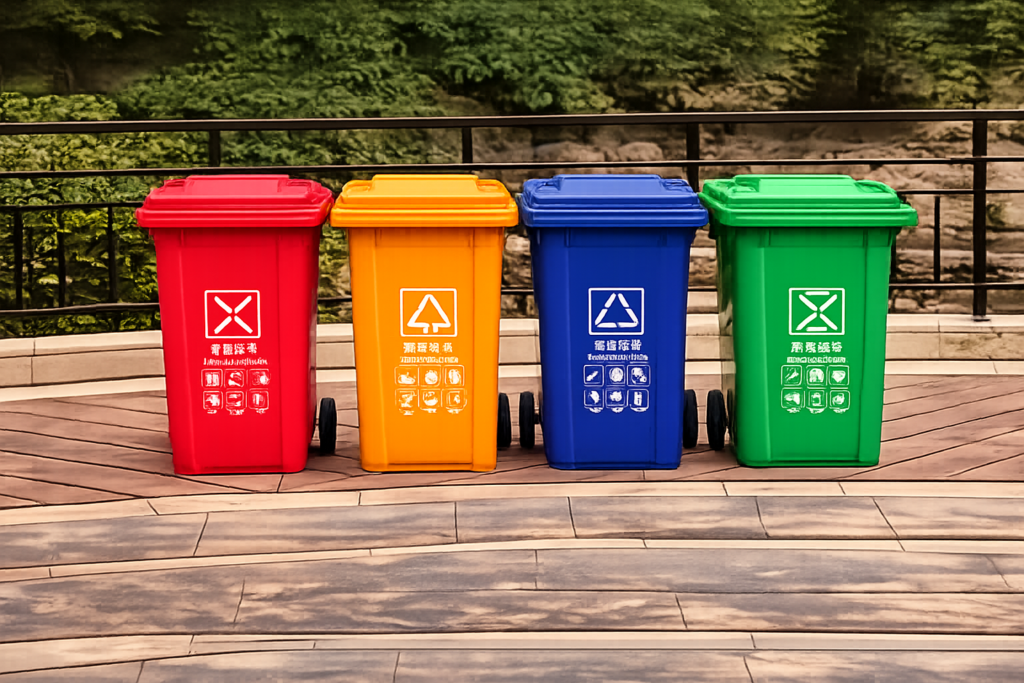
Outdoor recycling bins are not simply containers with different colored labels. In a park, campus, commercial plaza, transport area, or municipal streetscape, the bin system has to match the materials people discard, the local collection method, the cleaning route, the weather, and the way visitors move through the site. A visually attractive unit can still fail if the openings are confusing, the streams do not match the local hauler, or staff cannot empty it safely.
This buying guide explains how project teams can select outdoor recycling bins for public spaces without starting from appearance alone. It covers waste-stream planning, openings, signage, capacity, materials, placement, accessibility, installation, maintenance, and the information a manufacturer needs before quotation.
Planning a public-space waste station? Review Yubang Outdoor’s custom outdoor recycling and trash bins, or send your layout, quantity, preferred materials, and installation requirements for a project-specific discussion.
Outdoor Recycling Bin Buying Checklist
| Decision area | What the buyer should confirm | Why it matters |
|---|---|---|
| Waste streams | What the local collector accepts and whether materials are mixed or separated | The station must follow the real collection system |
| User behavior | Common items discarded at each location | Openings and labels should match the items people hold |
| Capacity | Peak use, collection frequency, liner size, and service access | Capacity is an operational decision, not only a volume number |
| Materials | Weather, corrosion exposure, impact risk, finish, and cleaning method | Outdoor conditions affect service life and appearance |
| Placement | Pedestrian route, gathering points, food areas, entrances, and collection route | Convenience affects use, while poor placement can obstruct movement |
| Installation | Freestanding, surface-mounted, embedded, or project-specific fixing | The base must suit the site and the project’s security needs |
| Maintenance | Door access, liner removal, drainage, replacement parts, and cleaning clearance | Routine servicing usually determines long-term usability |
Start With the Local Collection System
The first design question is not “How many compartments look good?” It is “Which materials can the local collection and processing system accept?” A site may collect mixed containers in one stream, separate paper and bottles, or include food waste. The answer varies by country, city, collector, and contract.
The U.S. Environmental Protection Agency’s guidance for recycling at sports venues recommends speaking with the hauler and local recycling officials before choosing containers. The guide also notes that the collection arrangement should reflect whether materials are accepted together or separately. This is practical advice for any public project: confirm the downstream system before approving the upstream bin.
Define Each Stream in Plain Language
Use the names visitors will understand, such as “Bottles and Cans,” “Paper,” “Food Waste,” or “General Waste.” A broad label such as “Plastic” can be misleading when the collector accepts only certain plastic containers. The project team should obtain the current accepted-material list and use it consistently on openings, front panels, maps, and staff instructions.
Do Not Add Compartments Without a Collection Route
Extra compartments increase manufacturing, liner, sorting, signage, and collection complexity. A four-stream station is useful only if four streams remain separate after the bags leave the site. If staff combine everything during collection, the station creates the appearance of recycling without an operational result.
Study What People Discard at Each Location
A campus café, a trail entrance, a bus stop, and a commercial plaza produce different waste. A short waste observation can show which items dominate, when containers fill, and where litter appears. Buyers do not need to guess capacity or openings from a catalog image when the site itself provides better evidence.
Map High-Generation Points
Mark entrances, exits, seating areas, food service points, vending locations, transport waiting zones, event areas, and paths to parking. These are common decision points where visitors are already holding an item they want to discard. The EPA advises placing collection bins near where recyclable materials are generated and pairing recycling with trash so both choices are equally convenient.
Check Peak Periods, Not Only Daily Averages
A bin that works on a quiet weekday may overflow after a school break, sports event, lunch period, or weekend market. Record the busiest intervals and compare them with the collection schedule. The required capacity may be solved by a larger liner, an additional station, or more frequent servicing. A larger cabinet is not always the best answer if it blocks circulation or becomes difficult to empty.
Choose Openings That Reinforce the Message
The opening is part of the sign. Round openings can suggest bottles and cans, narrow slots can suggest paper, and restricted openings can discourage bulky general waste. The shape should match the accepted materials and be large enough for normal use without inviting incorrect items.
Match Shape, Label, and Color
Users make decisions quickly. A station is easier to understand when the opening shape, written label, image, and color all communicate the same stream. Color alone is not enough because color conventions differ between regions and some users cannot distinguish every color. Use both words and clear graphics, and verify the local language needs.
Avoid Flat Surfaces That Collect Loose Waste
Flat tops often become shelves for cups, food trays, or bags. Sloped or shaped tops can reduce this behavior, although the exact form must still allow cleaning and rainwater management. EPA guidance for public recycling programs also recommends distinguishing recycling bins from trash containers and using openings that help reduce contamination.
Design Signage for Fast Decisions
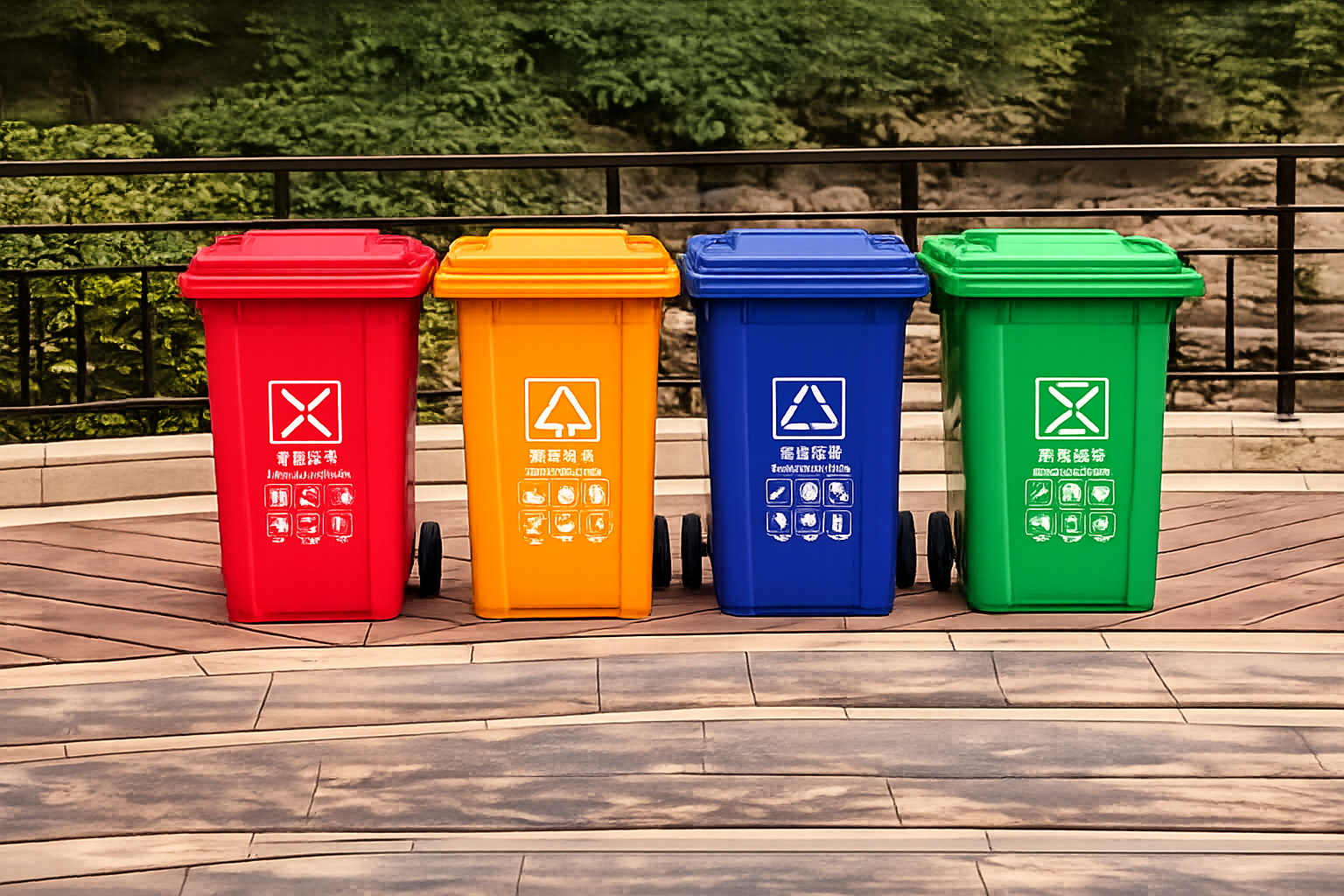
Good signage answers two questions immediately: what belongs here, and what does not? Use recognizable examples from the actual site. A transport station may show drink bottles, cans, newspapers, and general waste. A food court may need packaging, food scraps, and liquids addressed separately.
Use Pictures and Words Together
The EPA recommends labels that use both graphics and words. Pictures can help international visitors and reduce the reading burden, while words clarify materials that look similar. Keep the examples current with the local collection contract. If a material becomes unacceptable, the label should be replaceable without replacing the complete bin body.
Keep Signage Consistent Across the Site
A visitor should not have to relearn the system at every building or plaza. WRAP guidance for external litter bins recommends consistent bins and signage and placing a general-waste option with recycling containers to help limit contamination. The same stream should use the same name, color family, icon, and opening throughout the project.
Size Capacity Around Servicing
Nominal volume alone does not define useful capacity. Internal dividers, bag supports, opening geometry, and liner shape can reduce usable space. Wet or heavy materials may reach a safe lifting limit before a large liner is full. Ask operations staff how bags will be removed, moved, stored, and transferred to the collector.
Balance Capacity and Collection Frequency
A remote park area may need more capacity because collection is less frequent. A busy plaza with daily service may benefit from more compact stations placed at several decision points. Buyers should compare the cost of additional capacity with the labor and vehicle route required to empty it.
Provide Practical Service Access
Doors and liner frames should be accessible without moving the complete station. Staff need space to open the service side, remove bags, clean spills, and inspect fasteners. Confirm whether the service door should face a maintenance route rather than the pedestrian flow. Locks may be appropriate in some settings, but they add keys and service steps.
Select Materials for the Exposure
Outdoor recycling bins face rain, ultraviolet exposure, temperature changes, cleaning chemicals, impact, and sometimes salt or industrial pollution. The correct frame and panel material depends on this exposure and the maintenance plan. The material name alone does not describe thickness, grade, fabrication, coating, or joint protection.
Galvanized Steel
Galvanized steel is a common structural option for outdoor bins and can receive a powder-coated finish. Procurement documents should define the required finish, color, fabrication details, and any site-specific corrosion needs. Cut edges, weld areas, drainage points, and fasteners deserve the same attention as the large visible panels.
Stainless Steel
Stainless steel can suit projects that prioritize corrosion resistance and a clean architectural appearance. Buyers should still specify the grade and surface finish appropriate to the environment. Fingerprints, abrasive cleaning, coastal exposure, and dissimilar-metal contact can influence appearance and maintenance.
Aluminum Alloy
Aluminum alloy offers lower weight and corrosion resistance for suitable applications. Structural sections, panel thickness, joints, finish, and fixing details must match the bin size and exposure. Lightweight construction may simplify handling, but anchoring and stability still need project review.
For a broader comparison, review Yubang Outdoor’s materials and surface treatment guide and outdoor metal corrosion-prevention guide.
Plan Drainage, Weather Protection, and Cleaning
Rainwater should not collect on the top, around openings, or inside the base. The design may use roof-like covers, sloped surfaces, protected openings, drain paths, or removable internal containers. The right combination depends on wind-driven rain and whether the station is fully exposed or beneath a canopy.
Separate Water Management From Waste Containment
Drainage holes should release incidental water without allowing litter or liquids to spread across the pavement. Internal liners should contain normal leakage, and the cabinet should allow cleaning without trapping residue in inaccessible corners. Buyers should ask how the base, door thresholds, and internal frames are cleaned.
Specify the Cleaning Method
Define whether staff will wipe, hose, pressure-wash, or use specific cleaning products. Labels, coatings, hinges, locks, and seals should be compatible with that method. A finish that looks good at delivery can deteriorate if the approved cleaning process is never discussed.
Place Bins Without Blocking Movement
Bins should be easy to find but should not reduce the pedestrian route, boarding area, doorway clearance, or emergency access. Place stations where users naturally pause and where service staff can reach them without taking collection carts through crowded areas.
Consider Accessibility at the Complete Station
Opening height, approach space, reach, handles, and lids influence accessibility. For U.S. federal outdoor developed areas, the U.S. Access Board provides specific clear-ground-space and operable-part requirements for trash and recycling receptacles. Other countries and projects use different standards. Buyers should treat manufacturer drawings as inputs and have the responsible local professional verify the final layout.
Protect Sightlines and Safety Zones
A large station can hide pedestrians, signs, vehicles, or security views when placed near crossings and driveways. It can also create a climbing point beside a barrier. Review the complete surroundings, not only the footprint. The safest location may be slightly away from the highest traffic line while remaining visible and convenient.
Choose an Installation Method
Freestanding units can be flexible but may be moved, tipped, or stolen in some environments. Surface mounting connects the bin to an existing slab. Embedded fixings or project-specific foundations may suit permanent municipal installations. The correct method depends on the base material, wind exposure, vandalism risk, underground services, and maintenance strategy.
Ask for Fixing Information Before Site Work
Coordinate base dimensions, anchor positions, door swing, finished levels, drainage, and service clearance before pouring foundations or drilling finished paving. The supplier should receive site drawings and installation constraints early enough to reflect them in the production drawing.
Compare Options With a Procurement Matrix
| Site condition | Likely design response | Items to verify |
|---|---|---|
| Busy food-service area | Paired recycling and general-waste streams with large, visible signs | Common packaging, liquids, food waste, peak servicing |
| Open coastal site | Corrosion-conscious material and finish with protected openings | Material grade, coating system, fasteners, drainage |
| Campus network | Consistent modular station family across different locations | Shared labels, replaceable panels, variable stream count |
| Transport stop | Compact station outside the passenger route | Sightlines, boarding space, collection access, signage |
| Remote park area | Weather-protected capacity matched to a longer service interval | Wildlife, liner weight, vehicle access, secure closure |
| Commercial plaza | Architectural finish integrated with other site furniture | Brand colors, cleaning, drainage, anchoring, replacement parts |
Information to Include in an Outdoor Bin RFQ
- Project country, city, and application type
- Quantity and number of stations at each location
- Waste streams and accepted materials for every stream
- Site plans, photos, pedestrian routes, and service access
- Expected peak use and collection frequency
- Preferred dimensions, liner arrangement, and opening type
- Frame, panel, fastener, and finish requirements
- Color, icons, wording, language, logo, and replaceable signage needs
- Weather, corrosion, vandalism, and wildlife exposure
- Installation method and foundation responsibility
- Required drawings, samples, inspection records, packaging, and spare parts
- Delivery location and target schedule
Yubang Outdoor’s published YB-OF-002 product information lists galvanized steel, stainless steel, aluminum alloy, and customized material options, together with customizable dimensions, surface finishes, and installation details. Final materials and commercial terms should be confirmed in the project quotation. The custom project process explains how requirements, drawings, production details, inspection, packaging, and delivery information can be reviewed before shipment.
Common Outdoor Recycling Bin Buying Mistakes
Copying a Color System From Another Country
Color conventions are not universal. Confirm local rules and support color with words, icons, and opening shapes.
Selecting Compartments Before Confirming the Hauler
The downstream collector determines whether materials should be mixed or separated. A station should follow that decision.
Ignoring the Staff Service Route
Visitors see the front, but staff work from the door and liner side. Poor service clearance increases time and can damage nearby paving or planting.
Using One Capacity at Every Location
Waste generation and collection frequency vary. Standardize the visual family while allowing appropriate internal capacity and stream configuration.
Writing “Weatherproof” Without Testable Details
Procurement documents should define materials, finishes, drainage, fasteners, exposure, and maintenance instead of relying on a broad marketing word.
Frequently Asked Questions
How many compartments should an outdoor recycling bin have?
Use the number of streams supported by the local collection system. Confirm accepted materials with the hauler, then match openings and labels to those streams. More compartments are not automatically better if staff cannot keep the materials separate.
What material is best for outdoor recycling bins?
There is no single best material for every site. Galvanized steel, stainless steel, and aluminum alloy can all be suitable when the grade, thickness, finish, joints, fasteners, and maintenance plan match the environment. Coastal, industrial, high-impact, and sheltered sites may require different specifications.
Where should recycling bins be placed in public spaces?
Place them near where waste is generated and where people naturally make disposal decisions, such as entrances, seating, food-service points, and transport waiting areas. Keep the station visible, pair recycling with general waste where appropriate, and do not obstruct pedestrian or accessible routes.
How can outdoor recycling bins reduce contamination?
Match each opening to the accepted item, use consistent words and pictures, place recycling and general waste together, and keep signs visible. Monitor the contents after installation and revise labels or placement when repeated errors appear.
Can Yubang Outdoor customize recycling bin materials and signage?
Yes. Yubang Outdoor’s published YB-OF-002 product page lists customizable dimensions, material options including galvanized steel, stainless steel and aluminum alloy, surface finishes, colors, logos, and installation details. Buyers should send the project location, streams, quantity, site drawings, and preferred appearance so the final configuration can be confirmed in writing.
What should I send to request an outdoor recycling bin quote?
Send the required quantity, waste streams, target dimensions, material preference, colors and labels, installation method, project location, delivery schedule, and site photos or drawings. Include the local accepted-material list and collection frequency if available; these details help the supplier discuss a practical configuration rather than quote from appearance alone.
Final Recommendation
Choose outdoor recycling bins as part of a complete collection system. Confirm what the local hauler accepts, observe what visitors discard, decide where each station belongs, and involve cleaning staff before approving the design. Openings, signs, capacity, materials, drainage, accessibility, installation, and service access should support the same operational plan.
For a custom project, compare the YB-OF-002 outdoor recycling and trash bin with your site requirements, then send the project brief to Yubang Outdoor for configuration and quotation review.
Sources and Technical References
- U.S. Environmental Protection Agency: Recycling at Sports Venues
- U.S. Environmental Protection Agency: Zero Waste Special Event Best Practices Guide
- WRAP: Location of External Litter Bins
- U.S. Access Board: Outdoor Developed Areas, Trash and Recycling Receptacles
- Yubang Outdoor: Custom Outdoor Recycling and Trash Bins
