
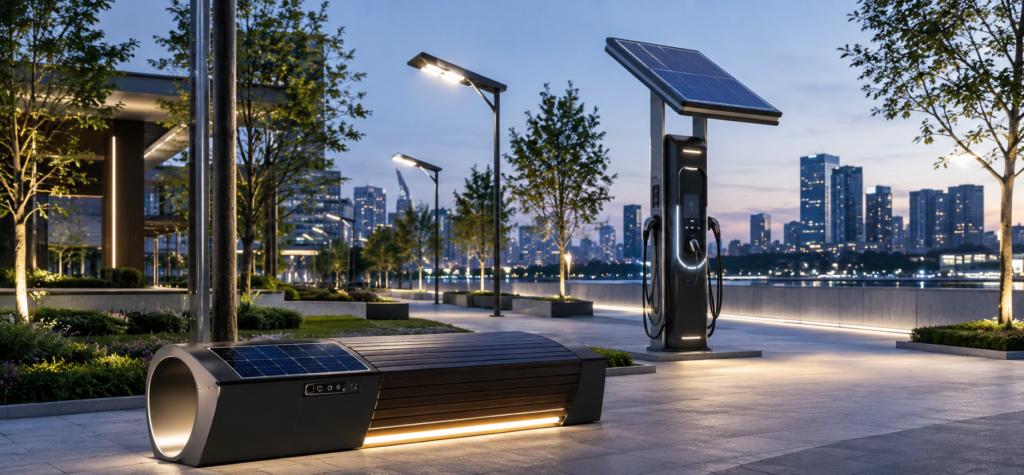
Smart solar outdoor products can add lighting, charging, information or public-service functions to parks, transit areas, campuses and commercial public spaces. They are not a universal replacement for grid power. Their value depends on whether the solar resource, battery, electrical load, structure and maintenance plan are designed as one system.
This guide explains how municipal buyers can evaluate solar benches, solar shelters, charging stations and other smart urban equipment. It focuses on procurement questions that can be confirmed through site information, drawings and supplier documentation. It does not assume that one standard configuration works in every city.
Article Roadmap for Municipal Buyers
| Section | Decision It Supports | Evidence to Request |
|---|---|---|
| Product types | Which functions belong in the project? | Product drawings, function list and application limits |
| Site and solar conditions | Can the proposed system operate at the intended location? | Shading information, solar assumptions and load calculation |
| Electrical configuration | Are panel, battery and devices matched? | Component schedule, control logic and protection details |
| Structure and installation | Can the equipment be installed and maintained safely? | Foundation, anchoring, cable and access drawings |
| Maintenance | Can the owner inspect and replace service parts? | Inspection plan, replacement method and spare-parts list |
| RFQ preparation | Can suppliers quote the same scope? | Location, quantities, functions, schedule and acceptance criteria |
What Are Smart Solar Outdoor Products?
Smart solar outdoor products combine an outdoor structure with a photovoltaic panel, battery, controller and one or more powered functions. Depending on the design, those functions may include LED lighting, device charging, information display, water-service controls or sensors. The word “smart” should describe a defined function, not simply a modern appearance.
Municipal projects may use this equipment where a useful public function can be supported without making every location dependent on a new underground power connection. Buyers should still compare solar, grid-connected and hybrid options. A site with high continuous loads or heavy shading may need a different solution from an open park with modest evening lighting requirements.
Common Smart Solar Product Types
Solar Smart Benches
A solar bench combines public seating with selected electrical functions. Possible features vary by configuration, so an RFQ should state whether the project needs wired charging, wireless charging, lighting or another service. Review the custom solar smart bench product page together with the solar bench specification checklist before comparing quotations.
Solar Canopy Benches
A canopy can provide shade while giving the solar panel a larger, elevated surface. This format affects wind loading, foundation design, drainage and cleaning access. Buyers evaluating solar canopy benches should coordinate the product drawing with the landscape and civil works teams rather than treating the unit as freestanding furniture.
Solar Charging and Lighting Stations
Standalone stations can support charging, lighting or visual landmark functions in plazas and recreational areas. The actual electrical demand must be stated. A supplier cannot size the solar and battery system accurately from the phrase “charging station” alone. The solar flower charging and lighting station page shows one product direction for project discussion.
Solar-Enabled Bus Shelters
Transit shelters may combine weather protection, seating, lighting, advertising panels or passenger information equipment. Some functions can be solar-supported, while others may require grid or communications infrastructure. A shelter project therefore needs coordination across the structure, route operations, electrical system and site foundation. See the custom bus shelter product page for related structural options and the solar smart bus shelter project page for an application reference.
Solar Public-Service Stations
Solar structures may also support public-service equipment such as a drinking-water station, subject to local utility, hygiene, electrical and maintenance requirements. Solar power does not remove the need to define the water source, drainage, freeze protection or service responsibility. The solar smart drinking-water station provides a starting point for configuration discussions.
Why Municipal Projects Consider Solar Equipment
Reduced Dependence on New Power Trenches
At some sites, a correctly sized stand-alone solar system can reduce the need for a new grid connection or long cable route. That may be useful where trenching would disturb finished paving, landscaping or an operating public area. This benefit is site-specific. The project team should compare connection distance, civil work, electrical load, shading and long-term maintenance before deciding.
More Functions in One Public-Space Element
A single structure can combine seating, shade, lighting and charging. Combining functions may simplify the visual layout, but it also creates dependencies. If the battery, controller or charging module needs service, the owner should be able to access it without removing the whole structure. Replaceable modules and documented wiring are therefore part of good product planning.
A Visible Smart-City Application
Solar equipment is easy for visitors to recognize, which can make it a visible part of a public-space upgrade. The project should still be judged by useful service, reliability and maintainability rather than by appearance alone. A smaller set of well-sited products can be more practical than widespread installation without a clear usage or service plan.
Site Conditions Come Before Product Selection
Sunlight and Shading
Trees, buildings, shelters and seasonal changes can reduce solar exposure. A site photograph taken at one time of day is not enough to establish annual conditions. Provide the proposed location, orientation and surrounding obstructions, and ask the supplier to state the assumptions used for system sizing. If the assumptions cannot be met, the project may need a larger system, a lower load, relocation or a grid-supported option.
Climate and Temperature
Battery behavior, electronics, coatings and seals are affected by temperature and moisture. Coastal air, heavy rain, dust, snow or freeze-thaw conditions may change the enclosure, ventilation and structural requirements. Buyers should describe the environment and request component limits that can be checked against local conditions.
Wind, Foundations and Public Use
Solar panels and canopies add surface area that can receive wind loads. The project engineer should review the structure, base plates, anchors and foundation for the site. Public access also requires attention to sharp edges, exposed wiring, climbable elements, tamper resistance and maintenance access. These details belong in drawings, not only in marketing text.
How to Review the Solar and Battery System
Start With the Electrical Load
List every powered device, its operating power, daily operating time and control schedule. Lighting used for several evening hours creates a different load from occasional phone charging. Displays, communications devices and pumps may add further demand. Without a load schedule, panel and battery values cannot be evaluated in context.
Ask for the Sizing Assumptions
The supplier should explain the solar-resource assumption, expected load, control strategy, battery reserve approach and any conditions that reduce available service. Buyers do not need to invent technical values. They should ask for a documented calculation based on the actual site and functions, then have the project’s electrical professional review it when required.
Confirm Protection and Service Access
Outdoor electrical parts need suitable protection against water, dust, overheating, short circuits and unauthorized access. Ask where the controller, battery, fuses or breakers and cable connections are located. Service doors should be accessible to authorized staff while remaining secure in public use. Replacement should not require damaging finished structural parts.
Structural Materials and Surface Treatment
The frame supports the solar system and remains exposed throughout the year. Buyers should confirm the base material, member sizes, welds, drainage, coating system, stainless or protected fasteners and treatment of cut edges. The right finish depends on the climate and structure. The materials and surface treatment guide explains the questions to include in a specification.
Panels, seats and covers also need to be evaluated for heat, UV exposure, cleaning and replacement. Dark surfaces in direct sun may become uncomfortable to touch. Decorative covers should not block ventilation or drainage. The design should allow technicians to reach components without creating loose parts in a public area.
Installation Planning for Municipal Sites
Coordinate Civil and Electrical Drawings
Confirm the foundation size, anchor pattern, finished ground level, drainage and any underground services before manufacturing. If a hybrid or grid-connected system is planned, show cable routes and isolation points. Misalignment between product drawings and site works can create delays even when the equipment itself is correctly manufactured.
Plan Delivery and Lifting
Canopies and integrated solar structures may arrive as large modules. Ask for packed dimensions, unit weight, lifting points and assembly sequence. The site team should confirm vehicle access, unloading space and the route to the foundation. Packaging also needs to protect panels, coatings and electrical modules during export and local handling.
Commission Before Public Use
Commissioning should confirm structural fixing, wiring, charging, lighting controls, protection devices and access doors. Record the installed configuration and provide the operator with diagrams, component information and maintenance instructions. A clear handover makes future troubleshooting faster and helps prevent unapproved changes.
Maintenance Is Part of the Specification
Solar products need planned inspection. Typical checks may include panel cleanliness and damage, fasteners, seals, cable condition, drainage, coating damage, battery or controller alerts and performance of each powered function. The appropriate interval depends on the site, component instructions and local operating experience.
Buyers should ask which components are replaceable, what tools are required, how access is controlled and whether replacement affects system settings. The solar bench maintenance guide offers a practical framework that can be adapted to other solar public-space equipment.
Municipal RFQ and Evaluation Checklist
| RFQ Item | Information to Provide | Supplier Response to Request |
|---|---|---|
| Site | Location, orientation, shade, climate and exposure | Environmental assumptions and product limitations |
| Functions | Lighting, charging, display, water or other service | Device list, operating logic and load schedule |
| Solar system | Required hours and expected usage pattern | Panel, controller and battery configuration with sizing basis |
| Structure | Layout, dimensions, materials and finish preference | General arrangement, member and connection details |
| Installation | Paving, foundation, power interface and access | Base, anchor, cable and assembly drawings |
| Maintenance | Owner, inspection capability and service access | Maintenance instructions and replaceable-parts list |
| Delivery | Destination, unloading limits and schedule | Packing, dimensions, weight and shipment plan |
To compare available product categories, visit the solar smart outdoor products collection. For a custom quotation, send the project location, required functions, quantities, drawings and target schedule through the contact page.
Frequently Asked Questions
Can smart solar outdoor products work without grid power?
Some configurations can operate as stand-alone systems, but only when the solar resource, battery and electrical load are matched. Shading, weather, operating hours and device demand can change the result. Ask for a site-based sizing calculation rather than assuming every product is fully off-grid.
What information is needed to size a solar bench?
Provide the location, shading, required lighting or charging functions, operating schedule and expected usage. The supplier should return the proposed components and sizing assumptions. Installation drawings and maintenance access should be reviewed at the same time.
Are solar bus shelters suitable for every transit stop?
No. A stop with adequate solar exposure and moderate electrical demand may be suitable, while a heavily shaded location or a high-load display system may need grid or hybrid power. Structural, operational and foundation requirements also need local review.
How should a municipality compare two quotations?
Compare the same functions, operating schedule, material, finish, foundation scope, component schedule, protection details, packaging and maintenance support. A lower price is not directly comparable if the battery, panel, structure or installation scope is different.
What maintenance do solar public-space products need?
Maintenance normally includes inspection of panels, structure, fixings, seals, cables, drainage, coatings and powered functions. Component instructions and local conditions should determine the schedule. Buyers should also confirm how batteries, controllers and service modules are replaced.
Can Yubang Outdoor customize solar equipment for a project?
Yubang Outdoor offers project-based configuration across solar benches, canopy benches, charging and lighting stations, bus shelters and related public-space products. Available functions and dimensions must be confirmed against the site and quotation. Send drawings, quantities and the required services so the team can discuss a suitable configuration without inventing unsupported specifications.
Conclusion
Smart solar outdoor products can be useful municipal assets when their public function is clear and the system is designed around real site conditions. A strong procurement process starts with the electrical load and solar exposure, then connects those requirements to the structure, foundation, maintenance access and handover documentation. This approach gives buyers a better basis for comparing suppliers and reduces the risk of selecting equipment only by appearance.
